
2025 NZ POTS Research

Greer E. Pugh, Kate N. Thomas, Jui-Lin Fan, and James P. Fisher. American Journal of Physiology-Heart and Circulatory Physiology 2026 330:1, H89-H99
Why we did this research:
Postural Orthostatic Tachycardia Syndrome (POTS) is a condition where the heart rate increases too much when standing, often leading to dizziness and fatigue. POTS can affect daily life in many ways, but the underlying mechanisms are not fully understood. In this study, we wanted to investigate whether differences in artery and vein structure and function might help explain symptoms in POTS.
What we did:
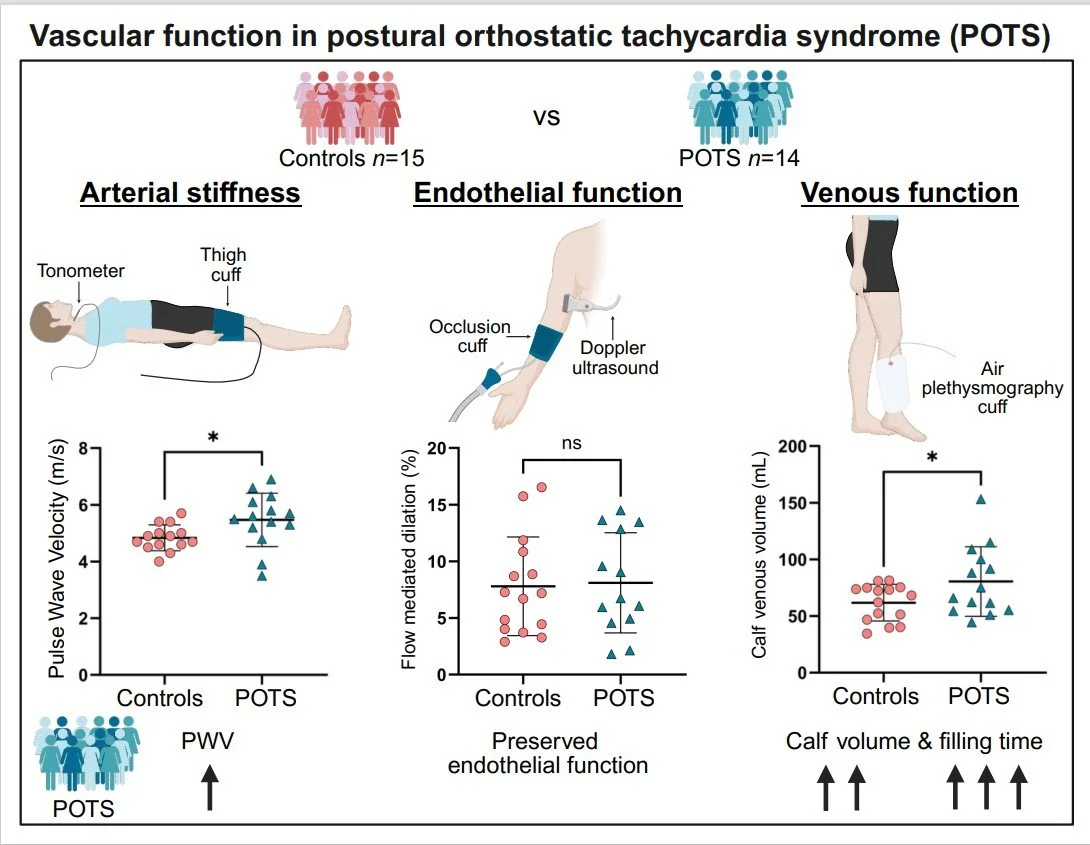
Fourteen females with POTS and fifteen control females volunteered for the study. We first measured how stiff the large arteries near the heart were using a technique called pulse wave velocity. Next, we investigated how well the artery in the arm responded to changes in blood flow (flow mediated dilation). Finally, we assessed how the veins in the leg function while lying down and standing up
What we learned:
In our study, we observed that people with POTS had:
Increased central artery stiffness.
No differences in blood vessel lining function in the arm.
More blood collected in the legs, with 29% greater calf volume and longer filling times during standing.
Why is this important:
Arterial stiffness: We believe the increased central artery stiffness in the POTS group may be from increased activity from the part of the nervous system (sympathetic nervous system) that controls blood vessel tightening. These values were still within the normal range for the general population, and more research is needed to understand if this becomes important as people with POTS get older.
Vein function: People with POTS had a 29% greater calf volume when standing which suggests more blood is collecting in the legs. This may be due to the blood vessels in the legs not tightening properly, the veins being stretcher, or the tiny blood vessels being leaker. Regardless of the underlying mechanism, when too much blood stays in the legs, it’s harder for it to return to the heart, which can lead to a faster heart rate and symptoms like dizziness and fatigue. Findings from this study suggest that treatments targeting the veins may help improve symptoms in POTS.
Where to next…
The next step in this research is to investigate how heart rate, blood pressure, and brain blood flow are regulated during standing, and whether differences in vein function affect the regulation of the cardiovascular system in people with POTS.
For more information
If you have any further questions about the study or are interested in participating in future research, please contact: greer.pugh@auckland.ac.nz
This Research would not have been possible without the wonderful support from
